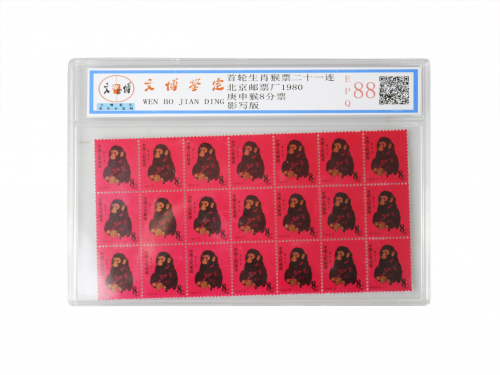
一、历史地位:新中国生肖邮票的“开山鼻祖”
1980年发行的庚申猴票(T46《庚申年》),是新中国首枚生肖邮票,也是首轮生肖邮票的“龙头”。其诞生标志着中国生肖文化的邮票化传承,开创了延续至今的生肖邮票发行传统。作为“第一枚”,它承载着特殊的历史意义,被誉为“邮票界的黄金起点”,是集邮者心中的“图腾级”藏品。
二、艺术价值:大师联袂,雕琢永恒经典
• 设计团队:由国画大师黄永玉亲自绘制原稿,邵柏林设计,姜伟杰雕刻,三位大师的强强联合,赋予猴票无与伦比的艺术生命力。 • 工艺细节:采用影雕套印技术,猴毛根根分明,金色线条黄中透亮,猴眼、鼻、嘴、耳等部位棱角分明,在阳光下甚至能呈现“毛发光泽”的立体效果,被誉为“邮票雕刻艺术的巅峰之作”。 • 文化符号:猴票以中国传统“金猴”形象为核心,大红底色寓意吉祥,既传承了生肖文化,又融入了现代审美,成为跨越时代的文化符号。
三、稀缺性:存世量稀少,市场一票难求
• 发行量:仅500万枚(整版80枚,共6.25万版),是十二生肖邮票中发行量最少的一枚。 • 消耗量:发行初期被大量用于通信贴用,加之早期收藏意识薄弱,实际存世量不足百万枚,整版邮票更是凤毛麟角。 • 市场表现: 拍卖纪录:2011年苏州拍卖会,整版猴票以120万元成交;2017年再以168万元刷新纪录。
四、收藏价值:市场风向标,抗跌性强
• 行情引领者:猴票价格走势与邮市大行情高度契合,被誉为“邮市风向标”。其价格波动往往预示着整体市场的趋势,是投资者判断市场冷暖的重要参考。 • 抗跌性:尽管邮市经历多轮调整,猴票始终保持“大涨小回”的强势特征。例如,2005年邮市低迷期,猴票价格仍逆势回升,彰显其“硬通货”属性。 • 文化认同:生肖文化深入人心,猴票作为“首枚”生肖邮票,具有不可替代的文化认同感,收藏群体跨越年龄层,需求持续旺盛。
五、升值空间:时间沉淀价值,未来潜力可期
• 历史涨幅:发行至今,猴票价格已上涨超15万倍(从0.08元到120万元整版),远超同期其他投资品。 • 未来趋势: 稀缺性加剧:随着时间推移,存世量进一步减少,尤其是品相完好的整版邮票,稀缺性将推动价格持续攀升。 • 文化溢价:生肖文化作为中国传统文化的重要组成部分,其邮票收藏价值将随文化复兴进程不断升华。 • 市场信心:尽管近期市场受假票泛滥、新邮打折等因素影响,但猴票作为“龙头品种”,其抗风险能力仍被资深藏家看好,长期升值逻辑未变。
六、投资与收藏建议
• 选择正规渠道:优先通过拍卖会、知名邮币卡交易平台或权威藏品机构购买,避免假票风险。 • 关注品相:全品相、带边纸、原胶未贴的猴票更具升值潜力,尤其是整版邮票,需特别注意保存环境。 • 长期持有:猴票的价值需时间沉淀,短期波动不影响其长期升值趋势,适合作为家族传承的“文化资产”。
结语
1980年庚申猴票,不仅是邮票史上的里程碑,更是中国收藏市场的“传奇符号”。它以稀缺性、艺术性和文化性,铸就了不可复制的收藏价值。无论从历史意义、市场表现还是未来潜力来看,它都是藏家不可错过的“压舱石”。如今,整版猴票起拍价已达120万元,但它的真正价值,远不止于数字——它是一段历史的见证,一份文化的传承,更是一个时代的收藏记忆。
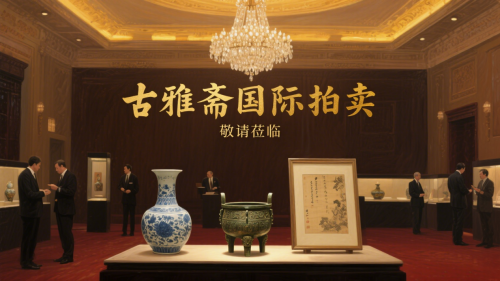
1980 Gengshen Monkey Stamp: The "Pioneering Work" of Zodiac Stamps, An Eternal Legend in the Collecting Market
1. Historical Status: The "Pioneer" of Chinese Zodiac Stamps. The Gengshen Monkey stamp (T46 "Year of the Monkey") issued in 1980 is the first Chinese zodiac stamp of the People's Republic of China and also the "leader" of the first round of Chinese zodiac stamps. Its birth marks the postal heritage of Chinese zodiac culture and establishes the tradition of issuing zodiac stamps that continues to this day. As the "first one", it carries special historical significance and is hailed as the "golden starting point" of the stamp world, serving as a "totem-level" collectible in the hearts of philatelists.
II. Artistic Value: Master Collaboration, Crafting Eternal Classics. Design Team: The original artwork was personally drawn by the Chinese painting master Huang Yongyu, designed by Shao Bolin, and carved by Jiang Weijie. The powerful combination of these three masters endows the Monkey stamp with unparalleled artistic vitality.
Process details: Using shadow carving and overprinting technology, the monkey's fur is distinctly visible, with golden lines that are yellow yet translucent. The monkey's eyes, nose, mouth, ears, and other parts are sharply defined, and in sunlight, they even exhibit a three-dimensional effect of "fur shimmering", thus being hailed as the "peak of stamp carving art".
Cultural Symbol: The monkey stamp features the traditional Chinese "Golden Monkey" image as its core, with a bright red background symbolizing auspiciousness. It not only inherits the zodiac culture but also integrates modern aesthetics, becoming a cultural symbol that transcends time.
III. Rarity: Limited availability, highly sought after in the market. Issue quantity: Only 5 million pieces (80 pieces per full sheet, 62,500 sheets in total), making it the least issued stamp among the twelve zodiac stamps.
Consumption: Initially, it was widely used for communication purposes, and due to the weak awareness of collecting in the early days, the actual number in existence is less than one million, with complete sheets of stamps being even rarer.
Market performance: Auction record: In the 2011 Suzhou auction, a full sheet of Monkey stamps sold for 1.2 million yuan; in 2017, it set a new record with a price of 1.68 million yuan.
IV. Collection Value: Market Indicator, Strong Resistance to Decline. Market Leader: The price trend of the monkey stamp is highly aligned with the overall market situation, earning it the title of "market indicator". Its price fluctuations often indicate the overall market trend and serve as an important reference for investors to gauge market sentiment.
Resilience: Despite multiple rounds of adjustments in the stamp market, the Monkey stamp has always maintained its strong characteristic of "rising sharply and falling slightly". For example, during the downturn of the stamp market in 2005, the price of the Monkey stamp still rebounded against the trend, demonstrating its "hard currency" attribute.
Cultural identity: The zodiac culture is deeply ingrained in people's hearts. As the "first" zodiac stamp, the Monkey stamp carries an irreplaceable sense of cultural identity. Its collectible group spans various age groups, and demand remains robust.
V. Appreciation Potential: Time Accumulates Value, Future Potential is Promising. Historical Increase: Since its issuance, the price of the monkey stamp has increased by over 150,000 times (from 0.08 yuan to 1.2 million yuan for a full edition), far exceeding other investment products during the same period.
Future Trends: Increased Scarcity: As time goes by, the number of existing stamps, especially those in mint condition and complete sheets, will further decrease. This scarcity will drive prices to continue to climb.
Cultural premium: As an important part of Chinese traditional culture, the collectible value of stamps featuring zodiac culture will continue to enhance with the process of cultural rejuvenation.
Market confidence: Despite the recent impact of factors such as the proliferation of counterfeit stamps and discounts on new stamps, the anti-risk ability of the Monkey stamp, as a "leading variety," is still optimistic by experienced collectors, and the long-term appreciation logic remains unchanged.
VI. Investment and Collection Advice: Choose Formal Channels: Prioritize purchasing through auctions, reputable stamp and currency trading platforms, or authoritative collectibles institutions to avoid the risk of counterfeit stamps.
Focus on product types: Full-size products, those with edge paper, and unadhered original gummed monkey stamps have greater potential for appreciation, especially full sheets of stamps, which require special attention to the preservation environment.
Long-term holding: The value of monkey stamps needs time to accumulate. Short-term fluctuations do not affect their long-term appreciation trend, making them suitable as "cultural assets" for family inheritance.
The conclusion: The 1980 Gengshen Monkey stamp is not only a milestone in the history of stamps, but also a "legendary symbol" in the Chinese collectibles market. Its scarcity, artistry, and cultural significance have created an irreplaceable collectible value. Whether from the perspective of historical significance, market performance, or future potential, it is a "ballast stone" that collectors cannot miss. Nowadays, the starting price for a full sheet of Monkey stamps has reached 1.2 million yuan, but its true value goes far beyond the numbers – it is a witness to a period of history, a legacy of culture, and more importantly, a collectible memory of an era.