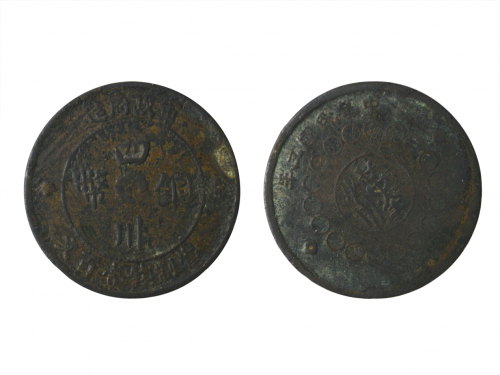
在浩如烟海的钱币收藏世界里,每一枚珍稀钱币都宛如一颗璀璨星辰,承载着独特的历史记忆与文化价值。军政府造四川铜币当制钱壹百文错版币,便是这样一件不可多得的珍品,它以独特的历史背景、罕见的错版成因、多重叠加的错版价值以及超越货币属性的收藏意义,吸引着无数藏家的目光。
一、历史背景:辛亥革命与四川军政府的金融革新
1911 年,辛亥革命的炮火如惊雷般划破长空,终结了中国长达两千多年的封建帝制,开启了历史的新纪元。四川,这片充满热血与激情的土地,于 12 月迅速响应革命号召,成立了大汉四川军政府。次年 4 月,军政府接管了成都造币厂,正式开启了“军政府造四川铜币”的铸造历程。
这一系列铜币,绝非仅仅是民国初期四川地区流通的普通货币,它更像是一部无声的史书,承载着“反满兴汉”的强烈政治诉求。铜币背面中央,那醒目的篆书“汉”字,被 18 个小圆圈紧密环绕,这 18 个小圆圈,恰似 18 颗闪耀的星辰,象征着辛亥革命中积极响应独立、挣脱封建枷锁的 18 个省份,寓意着“驱除鞑虏,恢复中华”的伟大理想。
此枚当制钱壹百文铜币,铸造于 1912 至 1925 年间。这一时期,四川大地军阀混战,局势动荡不安,军政府财政困窘,经济面临着巨大的挑战。这枚铜币的诞生,既是军政府为了稳定经济、缓解财政危机而采取的重要手段,也是那段动荡历史的真实实物见证,它见证了四川在民国初期的风云变幻与沧桑巨变。
二、错版成因:技术缺陷与历史偶然的碰撞
这枚铜币最为引人注目的,当属其独特的错版特征——正反面图案完全错位,即币面旋转 180 度后,正背图文仍能精准对应。这种极端的错位现象,犹如历史长河中一颗意外的流星,源于民国初期四川造币工艺的诸多局限性。
当时的成都造币厂,设备十分简陋。早期使用的手动压铸机,模具安装完全依赖人工定位。在繁琐的操作过程中,工人稍有不慎,就极易导致上下模反向安装,从而为错版币的出现埋下了隐患。而且,随着频繁的修模,模具上的定位标记逐渐磨损,工人在安装模具时,只能凭借经验进行操作,这无疑进一步增加了模具误装的风险。
此外,1916 年成都造币厂还遭遇了电力故障的困扰。由于电力不足,工厂频繁停机,而在每次重启时,模具错位的风险便会急剧增加。据重庆档案馆藏《四川造币厂记事簿》记载,1919 年 7 月,就曾因“模座机括失灵”,导致 300 余枚图文倒置的铜币被紧急追回。而这枚错版币,或许就是当时未被回收的“漏网之鱼”,其存世量极为稀少,更增添了它的神秘色彩与珍贵价值。
三、错版价值:稀缺性、工艺性与历史性的三重叠加
(一)稀缺性:存世量不足百枚的“孤品级”藏品
普通版的当制钱壹百文铜币,由于面值较大,在实际流通中的需求相对较低,因此铸造量本就稀少。而错版币更是因其模具错位的问题,被军政府视为影响政权合法性的“不祥之物”,进行了严格的追缴。如今,现存世的错版币数量不足百枚,可谓是凤毛麟角。
与同期普通版铜币相比,错版币的铸造失误率低于万分之一。而且,大部分错版币在发现后,要么被回收熔毁,要么因各种原因被人为销毁,能够流传至今且品相完好的更是少之又少。此枚错版币,无疑堪称“孤品级”的藏品,其稀缺性决定了它在收藏市场上的极高地位。
(二)工艺性:机械压铸与人工干预的矛盾体现
在正常的铜币压铸过程中,正背模具需要严格同轴对齐,以确保币面的图文准确无误。然而,这枚错版币的 180 度错位,却无情地暴露了民国初期造币技术从手工向机械化过渡过程中所经历的阵痛。
币面上的“流银”现象,即因模具压力不均而形成的金属溢出痕迹,与错位角度的精确性相互印证,充分证明了这枚错版币并非人为伪造,而是机械故障与人工操作失误共同作用下的产物。它就像一面镜子,清晰地映照出当时造币工艺的不足与局限,也为后人研究民国初期的造币技术提供了珍贵的实物资料。
(三)历史性:军阀割据与金融混乱的微观样本
这枚错版币的存世,犹如一把钥匙,为我们打开了民国初期四川军政府“边铸币边回收”矛盾政策的大门。军政府一方面需要通过铸造铜币来缓解财政危机,维持经济的运转;另一方面,又担心错版币的流传会影响政权的合法性,因此急于将其销毁。这种矛盾的政策,反映了当时四川军阀割据、金融混乱的复杂局面。
此枚铜币上的流通痕迹,如包浆、轻微磨损等,与错版特征并存,仿佛在诉说着它曾经的故事。它或许曾短暂地进入市场,在民众手中流转,成为人们口中“不祥之物”的传说载体。最终,因其稀缺性而被藏家珍藏,成为了这段历史的见证者。
四、收藏意义:超越货币属性的历史密码
这枚军政府造四川铜币当制钱壹百文错版币,早已超越了普通货币的范畴,它不仅是民国地方货币史的珍贵实物,更是解码四川军阀割据时期金融政策、造币技术与社会心理的“活化石”。
其错位角度的精确性、存世量的稀缺性,以及承载的“反满兴汉”政治符号,使其成为了钱币收藏领域中兼具学术价值与艺术价值的顶级藏品。对于藏家而言,它不仅仅是一枚具有经济价值的货币,更是民国历史的微观见证,是机械压铸技术发展史的独特标本。它的价值,远超货币本身,成为了连接过去与现在、历史与文化的桥梁,吸引着一代又一代的藏家为之痴迷、为之探索。
Military government-issued Sichuan copper coin as a misprinted version of a hundred-wen currency: a perfect blend of history and rarity In the vast world of numismatic collecting, every rare coin is like a shining star, carrying unique historical memories and cultural values. The military government-issued Sichuan copper coin as a misprinted version of a hundred-wen currency is such a rare treasure. With its unique historical background, rare cause of misprint, multiple layers of misprint value, and collectible significance beyond monetary attributes, it attracts the attention of countless collectors.
I. Historical Background: The Xinhai Revolution and the Financial Innovation of the Sichuan Military Government In 1911, the Xinhai Revolution, like a thunderbolt, shattered the sky, bringing an end to China's feudal monarchy that had lasted for over two thousand years and ushering in a new era in history. Sichuan, a land full of passion and enthusiasm, quickly responded to the revolutionary call in December and established the Great Han Sichuan Military Government. In April of the following year, the military government took over the Chengdu Mint, officially beginning the minting process of "Sichuan copper coins produced by the military government".
This series of copper coins is far more than just ordinary currency circulating in Sichuan during the early years of the Republic of China. It serves as a silent historical record, carrying strong political aspirations for "overthrowing the Manchus and reviving the Han Dynasty". On the back of the coin, the prominent seal character "Han" is surrounded by 18 closely packed small circles. These 18 small circles resemble 18 shining stars, symbolizing the 18 provinces that actively responded to the call for independence and broke free from the shackles of feudalism during the Xinhai Revolution, embodying the grand ideal of "expelling the barbarians and restoring China".
This copper coin, valued at one hundred wen (a traditional Chinese unit of currency), was minted between 1912 and 1925. During this period, Sichuan was embroiled in chaotic warfare among warlords, leading to a volatile and unstable situation. The military government faced financial difficulties, and the economy was confronted with immense challenges. The birth of this copper coin served as a crucial measure taken by the military government to stabilize the economy and alleviate the financial crisis. Moreover, it stands as a tangible testament to that tumultuous era, bearing witness to the significant changes and vicissitudes that Sichuan underwent in the early years of the Republic of China.
II. Causes of Misprint: The Confluence of Technical Defects and Historical Accidents The most striking feature of this copper coin is its unique misprint—the patterns on the obverse and reverse are completely misaligned. That is, even after rotating the coin by 180 degrees, the text and images on the obverse and reverse still align precisely. This extreme misalignment, akin to an unexpected meteor in the long river of history, stems from the numerous limitations of Sichuan's coinage craftsmanship in the early Republic of China.
At that time, the Chengdu Mint had very rudimentary equipment. The early manual die-casting machines used relied entirely on manual positioning for mold installation. During the tedious operation process, any slight carelessness by the workers could easily lead to the reverse installation of the upper and lower molds, thus laying the groundwork for the emergence of misprinted coins. Moreover, with frequent mold repairs, the positioning marks on the molds gradually wore away, and workers had to rely on their experience when installing the molds, which undoubtedly further increased the risk of incorrect mold installation.
In addition, the Chengdu Mint encountered power failures in 1916. Due to insufficient power, the factory frequently shut down, and the risk of mold misalignment increased dramatically during each restart. According to the "Sichuan Mint Record Book" stored in the Chongqing Archives, in July 1919, more than 300 copper coins with inverted graphics were urgently recalled due to "mold base mechanism failure". This misprinted coin may have been the "fish that escaped the net" that was not recalled at that time. Its extremely rare existence adds to its mysterious charm and precious value.
III. Value of Misprinted Coins: The Triple Overlay of Scarcity, Craftsmanship, and Historicity (1) Scarcity: The "unique-grade" ordinary version of the "Dangzhi Qianyi Baowen" copper coin, with a circulation of less than a hundred pieces, was originally minted in small quantities due to its relatively low demand in actual circulation given its large face value. Misprinted coins, furthermore, were regarded as "ominous objects" by the military government due to mold misalignment issues, and were strictly confiscated as they were deemed to affect the legitimacy of the regime. Today, the number of misprinted coins in existence is less than a hundred, making them truly rare and precious.
Compared to regular copper coins of the same period, the casting error rate of misprinted coins is less than one in ten thousand. Furthermore, most misprinted coins, once discovered, are either recycled and melted down or intentionally destroyed for various reasons, with very few surviving in good condition to this day. This misprinted coin is undoubtedly a "rare item" collectible, and its rarity determines its extremely high status in the collectible market.
(II) Technological Aspect: The contradiction between mechanical die-casting and manual intervention is evident in the normal process of copper coin die-casting, where the front and back molds must be precisely aligned coaxially to ensure the accuracy of the text and images on the coin surface. However, the 180-degree misalignment of this misprinted coin mercilessly exposes the transition pains experienced during the early Republic of China period as coinage technology shifted from manual to mechanized processes.
The "flowing silver" phenomenon on the coin surface, which refers to the metal overflow marks formed due to uneven mold pressure, corroborates the precision of the misalignment angle, fully demonstrating that this misprinted coin is not a man-made forgery but rather a product of a combination of mechanical failure and human operational errors. It is like a mirror, clearly reflecting the deficiencies and limitations of the coinage technology at that time, and also provides valuable physical materials for future generations to study the coinage technology in the early Republic of China.
(III) Historical Significance: A Microcosm of Warlordism and Financial Chaos The existence of this misprinted coin serves as a key, unlocking the door to the contradictory policy of the Sichuan Military Government in the early Republic of China, which was to "mint coins while recycling them." On the one hand, the military government needed to alleviate the fiscal crisis and maintain economic operations by minting copper coins. On the other hand, it was concerned that the circulation of misprinted coins would affect the legitimacy of its regime, and thus was eager to destroy them. This contradictory policy reflects the complex situation of warlordism and financial chaos in Sichuan at that time.
The circulation marks on this copper coin, such as patina and slight wear, coexist with the characteristics of a misprinted version, as if telling its past story. It may have briefly entered the market, circulating in the hands of the public, becoming the legendary carrier of the "ominous object" mentioned by people. Ultimately, due to its scarcity, it was treasured by collectors and became a witness to this period of history.
IV. Collection significance: A historical cipher beyond monetary attributes. This misprinted Sichuan copper coin, minted by the military government and intended as a currency of 100 wen, has long transcended the scope of ordinary currency. It is not only a precious material object in the history of local currency during the Republic of China period, but also a "living fossil" that decodes the financial policies, coinage technology, and social psychology during the period of Sichuan warlord separatism.
The precision of its misalignment angle, the rarity of its existence, and the political symbolism it carries, which represents the "anti-Manchurian and pro-Han" sentiment, make it a top-tier collectible in the field of numismatics, possessing both academic and artistic value. For collectors, it is not merely a currency with economic value; it is also a microcosmic witness to the history of the Republic of China and a unique specimen of the development history of mechanical die-casting technology. Its value far exceeds that of a currency itself, serving as a bridge connecting the past and the present, history and culture, attracting generation after generation of collectors to be fascinated by and explore it.