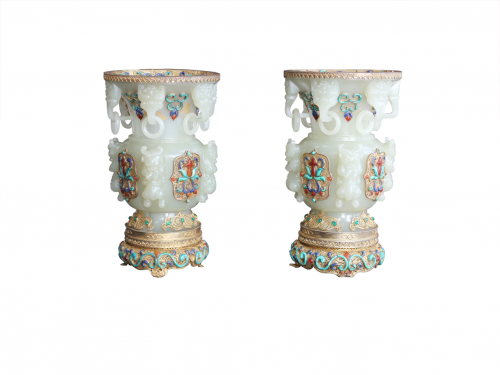
这对清代鎏金包玉镶宝石神兽尊,以精铜为胎,通体鎏金,尊身以和田玉雕琢神兽形态,辅以红宝石、蓝宝石、绿松石等珍贵宝石镶嵌,形成“金玉相辉、宝石争艳”的视觉奇观。其高20厘米、口径12厘米、底径10厘米的体量,既符合清代宫廷陈设器的庄重感,又通过神兽的灵动造型打破传统器物的呆板,堪称清代金属工艺与玉石雕刻的集大成者。
历史背景:盛世之下的工艺巅峰
1. 清代宫廷工艺的黄金时代
清代康乾盛世时期,国家统一、经济繁荣,为工艺美术的发展提供了坚实基础。乾隆皇帝对艺术极为痴迷,在宫廷内设立“造办处”,网罗全国顶尖工匠,形成了“内务府造办处”“苏州织造”“江宁织造”三大工艺中心。神兽尊的诞生,正是这一时期宫廷工艺“集大成”的产物,其融合了金属、玉石、宝石等多门类技艺,体现了清代“工不厌精、料不厌细”的造物理念。
2. 祥瑞文化的宫廷化表达
清代统治者作为少数民族入主中原,为巩固统治,大力推崇汉族传统文化中的祥瑞符号。神兽作为“天命”与“皇权”的象征,被广泛应用于宫廷器物中。例如,故宫博物院藏“清乾隆青玉嵌金瑞兽”与“清嘉庆掐丝珐琅瑞兽纹尊”,均以神兽为主题,通过夸张的造型与华丽的装饰,传递“江山永固”“万寿无疆”的寓意。这对神兽尊的创作,正是这一文化传统的延续。
3. 跨文化交流的实物见证
清代宫廷与中亚、西亚的交流频繁,金属工艺中的宝石镶嵌技法可能受到波斯、萨珊风格的影响。例如,尊身波浪纹的錾刻技法,与唐代萨珊风格银盘中的纹饰处理有异曲同工之妙;而宝石的切割方式(如红宝石的“糖面包山”切工),也与印度莫卧儿王朝的珠宝工艺存在关联。这种跨文化的融合,使神兽尊成为清代“西学东渐”与“中学西传”的见证。
文物鉴赏:从细节处见真章
1. 鎏金工艺:千年传承的皇家秘技
• 色泽与厚度:尊体表面采用清代宫廷“火镀金”工艺,金层厚度达5-8微米,历经数百年仍保持均匀光泽。局部因氧化形成的“包浆金”呈淡金黄至棕黄过渡,更添岁月沉淀的温润感。 • 錾刻细节:神兽背部的波浪纹以“阴刻”技法錾刻,线条流畅如行云流水,深浅变化自然,既突出云气的动感,又避免因过度雕刻破坏玉质主体。
2. 玉雕艺术:和田玉的极致表达
• 玉质与沁色:神兽主体以新疆和田白玉雕琢,玉质细腻如脂,局部可见自然沁色形成的浅黄与淡褐交织,符合《格古要论》中“润如凝脂,泽若春水”的顶级标准。 • 造型与动态:工匠运用“一料整做”技法,从整块玉石中直接雕出神兽轮廓。四肢伏地、昂首张口、须发飘逸的动态刻画,展现了清代玉工对动物形态的精准把握。尤其神兽尾部以“S”形弯曲,既增强动感,又通过线条的延伸与尊口形成呼应,体现“造物有法”的设计智慧。
3. 宝石镶嵌:皇家审美的奢华演绎
• 宝石选材:尊身镶嵌的红宝石、蓝宝石、绿松石等宝石,均经精心切割打磨。红宝石呈“鸽血红”色,蓝宝石为“皇家蓝”调,绿松石则选自湖北郧县“云盖寺”矿区,色泽纯正无杂。 • 镶嵌工艺:采用“爪镶”技法固定宝石,金爪细如发丝却坚韧有力,既确保宝石稳固,又通过金属的反光增强宝石的璀璨感。局部宝石边缘以金丝勾勒“连珠纹”,既装饰又起到保护作用,体现“实用与美观统一”的工艺理念。
4. 造型设计:神兽文化的创新诠释
• 神兽特征:神兽造型融合“天禄”与“辟邪”特征:独角象征“天禄”(天命禄位),双翼暗喻“辟邪”(驱邪避灾),虎身龙尾的合体设计则延续了汉代“博山炉”中神兽的造型传统。 • 象征系统:尊身以波浪纹象征云气流动,与神兽的动态形成呼应;神兽背负山峰的造型暗喻“江山永固”,口中衔珠的细节则象征“财源广进”。这种“一器多寓”的设计,既体现了清代宫廷对祥瑞文化的极致追求,也反映了工匠将复杂象征系统转化为视觉语言的卓越能力。
文化内涵:皇家信仰与工艺美学的交融
1. 祥瑞符号的集大成者
神兽尊集“天禄”“辟邪”“貔貅”等多种瑞兽特征于一体,其背负山峰的造型暗喻“江山永固”,口中衔珠的细节则象征“财源广进”。这种“一器多寓”的设计,既体现了清代宫廷对祥瑞文化的极致追求,也反映了工匠将复杂象征系统转化为视觉语言的卓越能力。
2. 宫廷造物的审美范式
作为清代宫廷陈设器,神兽尊的造型、工艺均遵循“中正典雅”的皇家审美。其体量适中(高20厘米),既适合摆放在案头或多宝阁,又通过神兽的威严感彰显主人身份;鎏金与玉石的搭配,则延续了乾隆时期“金玉相辉”的装饰传统,与故宫藏“清乾隆青玉嵌金瑞兽”等器物一脉相承。
3. 跨文化交流的实物见证
神兽尊的宝石镶嵌工艺,可能受到中亚、西亚金属器的影响。例如,尊身波浪纹的錾刻技法,与唐代萨珊风格银盘中的纹饰处理有异曲同工之妙。这种跨文化的工艺融合,印证了清代宫廷“博采众长”的艺术理念。
收藏价值:无款胜有款的宫廷遗珍
尽管底部无“乾隆年制”等官款,但通过以下特征可判定其为清代宫廷或贵族定制器物:
• 工艺水准:鎏金厚度、玉石选材、宝石镶嵌均达到清代官造标准,民间作坊难以企及; • 造型独特性:神兽的复合造型与动态设计,远超民间“吉祥图案”的程式化表达; • 文化符号系统:祥瑞寓意的密集使用,符合清代宫廷对器物“教化功能”与“装饰功能”的双重需求。
这对神兽尊以“无款胜有款”的姿态,成为研究清代宫廷工艺、神兽文化、跨文化交流的珍贵实物,其艺术价值与历史意义远超普通落款器物。
这对清代鎏金包玉镶宝石神兽尊,是金属工艺、玉石雕刻、宝石镶嵌的完美结合,更是清代宫廷文化、祥瑞信仰与审美趣味的集中体现。它们以静默的姿态,诉说着一个时代的工艺巅峰与文化自信,堪称中国传统文化中“器以载道”的典范之作。无论是从历史背景的深度、文物鉴赏的精度,还是文化内涵的广度,它们都无愧为清代宫廷艺术的瑰宝,值得世代珍视与传承。
"Qing Dynasty gilded and jade-encrusted divine beast statue with gemstones"
This pair of Qing Dynasty gilded jade-encased and gem-mounted divine beast statues are crafted from fine copper, with the entire body gilded. The statues' bodies are carved in the shape of divine beasts from Hotan Jade, complemented by precious gemstones such as rubies, sapphires, and turquoises, creating a visual spectacle of "gold and jade shining together, gemstones competing in beauty." With a height of 20 centimeters, a caliber of 12 centimeters, and a base diameter of 10 centimeters, the statues not only conform to the solemnity of Qing Dynasty court furnishings but also break the rigidity of traditional objects through the vivid shapes of the divine beasts. They are masterpieces that embody the culmination of Qing Dynasty metal craftsmanship and jade carving.
Historical background: The pinnacle of craftsmanship during the golden age of prosperity 1. The golden age of imperial craftsmanship in the Qing Dynasty
During the prosperous Kangxi-Qianlong era of the Qing Dynasty, the country enjoyed national unity and economic prosperity, laying a solid foundation for the development of arts and crafts. Emperor Qianlong, who was extremely fascinated by art, established the "Craft Office" within the palace, recruiting top craftsmen from across the country, forming three major craft centers: the "Imperial Household Department Craft Office," "Suzhou Silk Weaving," and "Jiangning Silk Weaving." The birth of the Divine Beast Vessel is precisely a product of the "integration" of court craftsmanship during this period, which combines various techniques such as metalwork, jade carving, and gem setting, reflecting the Qing Dynasty's philosophy of craftsmanship that "workmanship should never be too refined, and materials should never be too fine.".
2. The courtly expression of auspicious culture
The rulers of the Qing Dynasty, as an ethnic minority, took control of the Central Plains. To consolidate their rule, they vigorously promoted auspicious symbols from traditional Han culture. As symbols of "mandate of heaven" and "imperial power", mythical beasts were widely used in court artifacts. For example, the "Qing Emperor Qianlong Green Jade Inlaid Gold Mythical Beast" and the "Qing Emperor Jiaqing Cloisonné Enamel Mythical Beast Pattern Vase" housed in the Palace Museum both feature mythical beasts as their theme. Through exaggerated shapes and ornate decoration, they convey the meaning of "the country will remain stable forever" and "longevity without bounds". The creation of this pair of mythical beast vases is a continuation of this cultural tradition.
3. Physical evidence of cross-cultural communication
During the Qing Dynasty, there was frequent exchange between the imperial court and Central and West Asia, and the gem-inlaying techniques in metal craftsmanship may have been influenced by Persian and Sassanian styles. For instance, the wave-patterned chiseling technique on the body of the deity vessel bears similarities to the decorative treatments on Sassanian-style silver plates from the Tang Dynasty; while the cutting methods of gemstones (such as the "sugarloaf" cut of rubies) also have connections to the jewelry craftsmanship of the Mughal Dynasty in India. This cross-cultural fusion makes the deity vessel a testament to the "spread of Western learning to the East" and the "spread of Eastern learning to the West" during the Qing Dynasty.
Cultural relic appreciation: Seeing the essence through details 1. Gold gilding craftsmanship: A royal secret technique passed down for thousands of years. Color and thickness: The surface of the venerable object adopts the "fire gilding" craftsmanship of the Qing Dynasty court, with a gold layer thickness of 5-8 microns, maintaining a uniform luster after hundreds of years. The "patina gold" formed locally due to oxidation presents a transition from light golden yellow to brownish yellow, adding a warm and mellow feel of age accumulation.
Engraving Details: The wave patterns on the back of the mythical creature are engraved using the "intaglio" technique, with smooth lines flowing like clouds and water. The variations in depth are natural, emphasizing the dynamism of the clouds while avoiding excessive carving that might damage the main body of the jade.
2. Jade Carving Art: The Ultimate Expression of Hotan Jade Jade Quality and Infiltration: The main body of the mythical creature is carved from white Hotan jade from Xinjiang, with a delicate texture resembling creamy fat. Local areas show a natural infiltration of light yellow and light brown, which aligns with the top-tier standard described in "Essential Treatise on Ancient Art" as "moist like congealed fat, lustrous like spring water".
Shape and Movement: Craftsmen employ the technique of "working with a single piece of material" to directly carve the outline of mythical beasts from a single piece of jade. The dynamic portrayal of the beast with its four limbs on the ground, head raised, mouth open, and whiskers and hair flowing, demonstrates the precise grasp of animal forms by jade craftsmen in the Qing Dynasty. In particular, the tail of the mythical beast curves in an "S" shape, which not only enhances the sense of movement but also echoes the mouth through the extension of the lines, reflecting the design wisdom of "creating things according to laws".
3. Gemstone Inlay: A Luxurious Interpretation of Royal Aesthetics. Gemstone Se lection: The rubies, sapphires, turquoises, and other gemstones inlaid in the exquisite design have been carefully cut and polished. The rubies exhibit a "pigeon's blood" hue, the sapphires have a "royal blue" hue, and the turquoises are sourced from the "Yungaisi" mining area in Yun County, Hubei Province, boasting a pure and unadulterated color.
Inlaying technique: The gemstones are fixed using the "claw setting" technique. The gold claws are as thin as hairs yet tough and powerful, ensuring the stability of the gemstones while enhancing their brilliance through the reflection of metal. The edges of some gemstones are outlined with gold threads in a "bead pattern", serving both decorative and protective purposes, embodying the craftsmanship concept of "unity of practicality and beauty".
4. Styling Design: An Innovative Interpretation of Mythical Beast Culture. Mythical Beast Features: The mythical beast design combines the characteristics of "Tianlu" (auspicious fortune and position) symbolized by a single horn and "Bixie" (exorcism and disaster avoidance) implied by its wings. The integrated design of a tiger body and a dragon tail continues the tradition of mythical beast styling found in the "Boshi Burner" of the Han Dynasty.
Symbolic System: The body of the statue is adorned with wave patterns symbolizing the flow of clouds, echoing the movement of the mythical beast; the design of the mythical beast carrying a mountain peak implies "the eternal stability of the country," while the detail of the beast holding a pearl in its mouth symbolizes "prosperity and abundance." This "one object, multiple meanings" design not only reflects the Qing Dynasty court's ultimate pursuit of auspicious culture, but also showcases the craftsmen's remarkable ability to transform complex symbolic systems into visual language.
Cultural Connotation: The Fusion of Royal Beliefs and Craft Aesthetics 1. The epitome of auspicious symbols, the revered mythical beast, integrates various auspicious beast characteristics such as "Tianlu" (a symbol of good fortune), "Bixie" (a symbol of protection against evil), and "Pixiu" (a symbol of wealth and prosperity). Its design, featuring a mountain on its back, symbolizes "the eternal stability of the country," while the detail of holding a pearl in its mouth signifies "abundant wealth." This design, which "embodies multiple meanings within a single object," not only reflects the Qing Dynasty court's ultimate pursuit of auspicious culture but also showcases the craftsmen's remarkable ability to transform complex symbolic systems into visual language.
2. As a court furnishing object of the Qing Dynasty, the aesthetic paradigm of court creations is reflected in the shape and craftsmanship of the mythical beast vessel, which follows the royal aesthetic of "moderation and elegance". Its moderate size (20 centimeters high) makes it suitable for placement on a desk or in a multi-treasure cabinet, while also showcasing the owner's status through the majesty of the mythical beast. The combination of gold gilding and jade continues the decorative tradition of "gold and jade complementing each other" from the Qianlong period, and is in line with objects such as the "Qing Dynasty Qianlong jade inlaid with gold mythical beast" collected in the Forbidden City.
3. The physical evidence of cross-cultural exchange, such as the gem inlaying craftsmanship of the divine beast statue, may have been influenced by metalware from Central Asia and West Asia. For instance, the chiseling technique of the wave pattern on the statue's body bears a striking resemblance to the pattern decoration on the Sassanian-style silver plates of the Tang Dynasty. This cross-cultural fusion of craftsmanship underscores the artistic philosophy of the Qing Dynasty court, which advocated for "embracing diverse strengths".
Collection Value: Although the imperial relics without official marks surpass those with marks, they can still be identified as custom-made objects for the Qing Dynasty court or nobility through the following characteristics: Craftsmanship Level: The thickness of gilding, se lection of jade, and gemstone inlaying all meet the official standards of the Qing Dynasty, which are difficult for civilian workshops to match; Unique Design: The composite shape and dynamic design of mythical beasts far surpass the stylized expression of folk "auspicious patterns"; Cultural Symbol System: The intensive use of auspicious meanings aligns with the Qing Dynasty court's dual requirements for the "educational function" and "decorative function" of objects.
This pair of mythical animal statues, with their "no inscription surpasses having inscriptions" attitude, has become a precious material object for studying Qing Dynasty court craftsmanship, mythical animal culture, and cross-cultural exchanges. Its artistic value and historical significance far surpass ordinary inscribed objects.
Conclusion: This pair of Qing Dynasty gilded jade-encrusted and gem-mounted mythical beast statues represents a perfect fusion of metal craftsmanship, jade carving, and gem inlaying. It is also a concentrated embodiment of Qing Dynasty court culture, auspicious beliefs, and aesthetic tastes. With their silent posture, they narrate the peak of craftsmanship and cultural confidence of an era, and can be regarded as a paradigm of "using objects to convey ideas" in Chinese traditional culture. Whether it is from the depth of historical background, the precision of cultural relic appreciation, or the breadth of cultural connotation, they are truly treasures of Qing Dynasty court art, worthy of being cherished and passed down from generation to generation.