基本信息
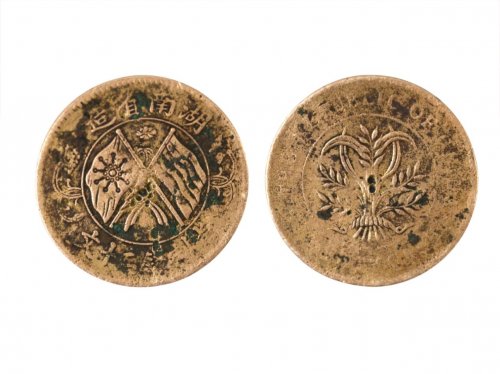
• 年代:民国 • 品类:古钱币 • 尺寸:直径32cm,重量9.7g,厚度9.7mm
共和印记 铜韵传承——湖南省造当制钱二十文双旗币精品推荐
在民国机制铜元的收藏版图中,湖南省造当制钱二十文双旗币是兼具历史厚度、版别丰富度与工艺精度的"标杆级"藏品。它诞生于辛亥革命后的政权更迭之际,以鲜明的共和符号取代了封建龙纹,既承载着稳定地方金融的使命,又镌刻着新旧时代交替的烙印。其中稀缺版别凭借极低的存世量与独特的铸造特征,成为藏家竞逐的珍品,堪称民国铜元收藏领域的"价值高地"。
历史溯源:共和新政下的货币革新
这枚双旗币的铸行,是民国初年政治变革在货币领域的直接投射。1912年中华民国成立后,湖南作为南方革命的核心根据地,率先响应财政部"废除帝制象征,采用共和标志"的币制改革号召,由长沙铜元局(前身为清末湖南铜元局)主导铸行新式铜元。彼时湖南正处于军阀谭延闿主政时期,为缓解军费压力、稳定地方经济,造币厂在延续晚清二十文币值体系的基础上,对钱币图案进行了颠覆性革新——以交叉双旗取代清代龙纹,用嘉禾纹饰传递民生愿景,完成了从封建货币到共和货币的符号转型。
其铸行跨度从1912年持续至1927年,见证了民国初年湖南乃至全国的政局动荡与经济变迁。作为地方铸币的典型代表,它不仅是日常流通的支付工具,更暗含着"彰显共和、凝聚民心"的政治意义,是那段新旧交替岁月里最鲜活的微观历史标本。
工艺鉴赏:民国铸币的匠心体现
这枚双旗币的工艺水准,代表了民国初年地方机制币的最高水平,从细节处可辨其"官方铸币"的身份
材质与形制:主流采用高纯度黄铜(含铜量75%-80%),部分早期版别为红铜材质,上手沉实有"压手感",形制规整无变形,外郭圆润无毛刺。
文字与图案:"湖南省造""当制钱二十文"字体为楷书,笔画刚劲清晰,无粘连模糊;双旗图案线条流畅,旗帜褶皱、旗杆细节完整,仿佛迎风飘扬;背面嘉禾纹饰颗粒饱满,叶脉纹路清晰可辨,寓意"五谷丰登",呼应民国初年"实业救国"的理念。
包浆与锈色:真品包浆自然温润,流通品多呈浅褐色或深黄色,分布不均且有层次感,用酒精轻擦无掉色;未流通品则带有淡金色原光,无化学做旧的僵硬感。湖南地区出土的部分藏品还会形成坚硬的"绿锈包浆",被藏家称为"美人锈",是品相完好的重要标志。
一枚小小的湖南省造当制钱二十文双旗币,既是共和新政的货币见证,也是民国工艺的匠心结晶。从稀缺的错版珍品到亲民的标准版,它覆盖了不同收藏层级的需求,让每个藏家都能通过这枚钱币,触摸到百年前的时代脉搏。在民国钱币收藏热度持续攀升的当下,无疑是兼具文化意义与投资价值的优质之选。
Impressions of the Republic, Legacy of Copper: Premium Recommendation of the Hunan Provincial Mint 20-Cash Double Flag Coin
In the collection landscape of Republic of China (ROC) machine-struck copper coins, the 20-Cash Double Flag Coin minted by Hunan Province stands as a "benchmark" collection integrating profound historical significance, rich varieties, and exquisite craftsmanship. Born amid the political transition following the 1911 Revolution, it replaced the feudal dragon pattern with distinctive republican symbols, shouldering the mission of stabilizing local finance while engraving the marks of the alternation between old and new eras. Among them, the rare varieties, with their extremely low survival quantity and unique casting characteristics, have become treasures pursued by collectors, worthy of being called the "value highland" in the field of ROC copper coin collection.
I. Historical Origin: Currency Innovation Under the Republican New Deal
The minting of this Double Flag Coin is a direct reflection of the political changes in the monetary field in the early years of the Republic of China. After the establishment of the Republic of China in 1912, Hunan, as a core base of the southern revolution, took the lead in responding to the Ministry of Finance's call for currency reform of "abolishing imperial symbols and adopting republican emblems". The Changsha Copper Coin Bureau (formerly the Hunan Copper Coin Bureau of the late Qing Dynasty) took the lead in minting new-style copper coins. At that time, Hunan was under the governance of warlord Tan Yankai. To ease military expenditure pressure and stabilize the local economy, the mint, on the basis of continuing the 20-cash currency system of the late Qing Dynasty, carried out a subversive innovation on the coin design—replacing the Qing dragon pattern with crossed double flags and using Jiahe (hyacinth bean) patterns to convey people's aspirations for a better life, completing the symbolic transformation from feudal currency to republican currency.
Its minting spanned from 1912 to 1927, witnessing the political upheavals and economic changes in Hunan and even the whole country in the early years of the Republic of China. As a typical representative of local minted coins, it was not only a means of payment for daily circulation but also implied the political significance of "showcasing republicanism and uniting people's hearts", serving as the most vivid micro-historical specimen of that era of transition between old and new.
II. Variety Decoding: The Value Divide Between Rare and Common Versions
The collection value of the Hunan Provincial Mint 20-Cash Double Flag Coin depends fundamentally on the differences in varieties—common versions have a survival quantity in the "tens of millions", with affordable values; while rare varieties, due to their extremely small minting volume, have become "hard currency" in the collection market. The following three core varieties deserve key attention:
1. Peak Treasure: Double-Obverse/Double-Reverse Error Versions
These varieties are official mistakes caused by "die misalignment" during the minting process, divided into "double-obverse versions" (both sides with double flag patterns) and "double-reverse versions" (both sides with Jiahe patterns). Most of them were destroyed after discovery, with a minting volume of less than 10,000 pieces and an extremely scarce existing quantity. Their core feature is the complete repetition of patterns without the "obverse-reverse distinction" of regular coins, and the basic craftsmanship such as characters and edge teeth is consistent with genuine products, without traces of manual modification. In a Beijing spring auction in 2025, a PCGS AU50 graded double-reverse version was sold for 280,000 yuan, demonstrating its status as a "treasure of ROC copper coins".
2. Rare Premium: Five-Star Version and English Edge Version
The core identifier of the Five-Star Version is two hollow five-pointed stars above the double flags (the standard version mostly has one or no stars), and there are also "fine dot marks" hidden in the center of the Jiahe grains on the reverse. Due to the more complex minting process, its minting volume is only 1/100 of the standard version, with an existing quantity of less than 1 million pieces. In an autumn auction in 2024, an MS60 graded Five-Star Version was sold for 23,000 yuan, making it a core target for mid-range collections.
The English Edge Version is a special variety minted in 1918 to adapt to border trade. The edge of the coin is engraved with the English "THE REPUBLIC OF CHINA", and there are pearl patterns below the double flags on the obverse. It only circulated on the border between Hunan and the two Guangxi (Guangdong and Guangxi) provinces, with a minting volume of less than 5 million pieces. The market price of this variety graded NGC AU50 is about 5,000-8,000 yuan, and MS58 graded ones can reach 15,000-20,000 yuan, combining scarcity and historical particularity.
3. Entry-Level Choice: Standard Version
The Standard Version is the main circulation variety, with a minting volume exceeding 1 billion pieces. 90% of the Hunan 20-Cash Double Flag Coins on the market belong to this category. The obverse features crossed 18-Star Iron-Blood Flag and Five-Color Flag without special decorations on the flag surfaces, and the four characters "Hunan Provincial Mint" are in regular Song typeface; the number of Jiahe grains on the reverse is fixed (11 on the left and 10 on the right), without hidden marks or English edge decorations. Although the existing quantity is large, well-preserved circulation premium products (AU50 graded) still have a market value of 800-1,200 yuan, suitable for beginners to build a basic collection system.
III. Craft Appreciation: The Ingenuity of ROC Minting
The craftsmanship of this Double Flag Coin represents the highest level of local machine-struck coins in the early years of the Republic of China, and its "official minted coin" identity can be distinguished from the details:
•
Material and Shape: The mainstream adopts high-purity brass (copper content 75%-80%), and some early varieties are made of red copper. It feels solid and "weighty" when held in the hand. The standard size is about 32mm in diameter, 1.5mm in thickness, and about 10.2g in weight. The shape is regular without deformation, and the outer edge is smooth without burrs.
• •
Characters and Patterns: The characters "Hunan Provincial Mint" and "20-Cash" are in regular script, with strong and clear strokes without adhesion or blurriness; the lines of the double flag patterns are smooth, with complete details of flag folds and flagpoles, as if fluttering in the wind; the Jiahe patterns on the reverse have full grains and clearly distinguishable leaf veins, implying "bumper harvests of grains" and echoing the concept of "saving the country through industry" in the early years of the Republic of China.
• •
Patina and Rust Color: The patina of genuine products is natural and warm. Circulation products are mostly light brown or dark yellow, with uneven distribution and a sense of hierarchy, and will not fade when lightly wiped with alcohol; uncirculated products have a pale golden original luster without the stiff feeling of chemical aging. Some collections unearthed in Hunan will also form a hard "green rust patina", known as "beauty rust" by collectors, which is an important symbol of good quality.
•
IV. Collection Guide: Authenticity Identification and Value Judgment
1. Core Points for Authenticity Identification
Most counterfeits on the market are made by sand casting and can be identified from three aspects: first, looking at characters and patterns—counterfeits have adhered strokes, blurred flag surface lines, and Jiahe grains without a sense of three-dimensionality, and even missing grains; second, checking edge teeth and materials—genuine products have about 144 straight edge teeth with uniform spacing, made of brass without magnetism; counterfeits are mostly manually filed with chaotic tooth counts, and some contain iron cores that can be adsorbed by magnets; third, distinguishing patina—counterfeits are mostly chemically aged with uniform and stiff patina, which will fade when wiped with alcohol, and even have a pungent smell.
2. Value Judgment Formula: Variety + Quality
For the same variety, the difference in quality will lead to a huge value gap: for example, the Standard Version graded XF40 (circulated medium grade) is about 300-500 yuan, while AU50 (near uncirculated grade) can reach 800-1,200 yuan; the Five-Star Version graded AU50 is about 8,000-12,000 yuan, and MS60 graded ones double directly to 20,000-30,000 yuan. At the same time, we need to be alert to the trap of "fake error versions". The "error versions" re-carved from the Standard Version on the market have obvious knife marks at the re-carved places, and their value is only 10%-20% higher than that of the Standard Version, which needs to be carefully distinguished.
3. Collection Suggestions
Beginners can start with the Standard Version, giving priority to well-preserved circulation premium products with clear character mouths and no repairs; advanced collectors can focus on the Five-Star Version and English Edge Version, avoiding authenticity risks through authoritative grading (PCGS, NGC); high-end collectors can layout treasures such as the Double-Obverse/Double-Reverse Version. Such collections have strong long-term value preservation capabilities and are the "ballast stones" of the collection system.
A small Hunan Provincial Mint 20-Cash Double Flag Coin is not only a monetary witness to the republican new deal but also a crystallization of the ingenuity of ROC craftsmanship. From rare error version treasures to affordable standard versions, it covers the needs of different collection levels, allowing every collector to touch the pulse of the era a hundred years ago through this coin. With the continuous rise of the popularity of ROC coin collection, choosing a well-preserved Hunan 20-Cash Double Flag Coin with a clear variety is undoubtedly a high-quality choice that combines cultural significance and investment value.