一、权威出品,品质保障
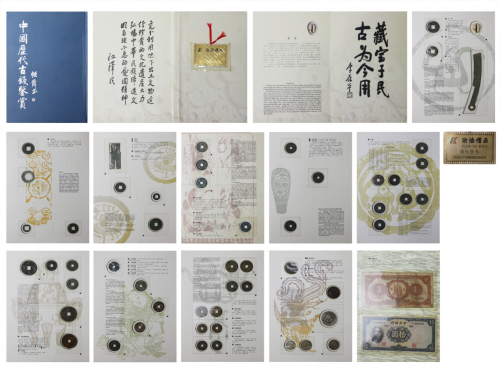
本册《中国历代古钱币鉴赏》由专业权威机构精心编纂发行,在古钱币收藏领域具备极高的公信力与专业性。其内容经过众多资深钱币专家、历史学者反复考证与甄选,确保所收录的每一枚古钱币都具备真实的历史价值与收藏意义。同时,随册附带的纯金“翰池礼品”牌,由知名贵金属工艺品牌“翰池”打造,采用高纯度黄金精制而成,工艺精湛,品质卓越,为整部鉴赏册增添了无与伦比的奢华质感与收藏价值。
二、古钱币:穿越时空的历史见证
(一)先秦货币——文明起源的印记
• 贝币:作为中国最早的货币形式,商周时期的海贝币以及仿贝币(如石贝、骨贝)在本册中均有呈现。这些小巧的贝币,不仅是早期商品交换的媒介,更反映了当时沿海与内陆地区之间的贸易往来。例如,商代铜贝,其表面精心雕刻的齿纹,与真实海贝极为相似,展现了古人高超的仿制技艺,是研究古代经济与文化交流的重要实物资料。 • 布币:起源于农具铲,主要流行于三晋地区。本册收录的晋国“武字空首布”,造型独特,铲形币身搭配空首设计,既保留了农具的实用特征,又赋予了其货币的流通功能。这种布币存世量稀少,全品相者市场价值极高,是先秦货币中的珍品之一。 • 刀币:由实用刀具演变而来,是齐、燕等国的主要货币形式。齐国“六字刀”(钱文“齐建邦长法化”),字体刚劲有力,刀身厚重,彰显出齐国的强大国力与繁荣经济。其存世量不足百枚,在古钱币收藏市场上备受追捧,单枚成交价曾突破数百万元。
(二)秦汉至隋唐——统一与变革的旋律
• 秦半两:秦始皇统一六国后,以圆形方孔的“半两”钱统一全国货币,奠定了中国历代货币的基本形制。“战国秦半两”与“秦统一半两”在本册中形成鲜明对比,前者字体豪放不羁,后者则规整严谨,反映了秦国在统一前后的货币制度演变。秦半两不仅具有极高的历史价值,其市场价值也随着存世量的减少而不断攀升。 • 汉五铢:汉武帝元狩五年始铸,是中国历史上流通时间最长、铸量最大的货币之一。本册收录的“西汉三官五铢”,钱文端庄秀丽,铸造工艺精湛,体现了汉代货币制度的成熟与完善。而“鸡目五铢”则以其极小的尺寸(直径不足1厘米)而闻名,存世量稀少,市场价值远超普通五铢钱。 • 新莽货币:王莽新朝时期推行了一系列货币改革,其铸造的钱币以精美著称。“大泉五十”存世量不足百枚,因其铸造精美、稀有性高,成为藏家竞相追逐的对象。
(三)宋元明清——艺术与技术的巅峰
• 宋钱书法:宋代是中国书法艺术的鼎盛时期,钱币上的钱文也成为了书法家展示才华的舞台。宋太宗“淳化元宝”以真、行、草三体书写,开创了“对钱”的先河;宋徽宗“崇宁通宝”“大观通宝”则以其独特的瘦金体书写,被誉为“钱中艺术品”。本册收录的“崇宁通宝母钱”(铸造模具),更是研究宋代货币铸造工艺的重要实物资料,市场价值极高。 • 明代洪武通宝:明太祖朱元璋洪武年间铸造的“洪武通宝”,分五等(小平、折二、折三、折五、当十),背面标注铸造局(如“北平”“浙”“豫”等),具有丰富的历史信息。其中,“洪武通宝当十背十福”存世量极少,市场价值超数十万元,是明代钱币中的珍品。 • 清代机制币及民国孙中山纸币。
三、纯金“翰池礼品”牌:奢华与艺术的完美融合
(一)材质珍贵
纯金“翰池礼品”牌采用高纯度黄金精心打造,黄金质地柔软、色泽亮丽,具有极高的保值与增值潜力。其纯度经过严格检测,确保符合国家标准,为收藏者提供了可靠的品质保障。
(二)工艺精湛
“翰池”作为知名贵金属工艺品牌,以其精湛的工艺闻名于世。该礼品牌表面经过精细打磨处理,光滑如镜,反射出耀眼的光芒;同时,运用浮雕、镂空等传统工艺技法,在牌面上雕刻出精美的图案与文字,如古代钱币的造型、吉祥纹饰等,既体现了中国传统文化的深厚底蕴,又展现了现代工艺的精湛技艺。
(三)设计独特
礼品牌的设计独具匠心,将古钱币元素与现代审美理念相结合。其形状借鉴了古代圆形方孔钱的形制,寓意“天圆地方”,象征着宇宙的和谐与秩序;牌面上的文字与图案布局合理,疏密得当,给人一种庄重、典雅的美感。此外,礼品牌还配备了精美的包装盒,采用高档材质制作,外观华丽大气,内部设计合理,能够有效保护礼品牌不受损坏,是赠送亲友、商务往来的高端礼品选择。
四、收藏与投资价值
(一)学术研究价值
本册《中国历代古钱币鉴赏》完整呈现了中国货币史的发展脉络,所收录的古钱币涵盖了各个历史时期的重要品种,为研究古代经济、文化、政治等方面提供了丰富的实物资料。对于历史学者、钱币爱好者来说,是一本不可多得的研究参考书。
(二)艺术欣赏价值
古钱币上的书法、图案、造型等都具有极高的艺术价值。从先秦的古朴简约到宋元的精致典雅,再到清代的华丽繁复,每一枚钱币都展现了不同历史时期的艺术风格与审美情趣。而纯金“翰池礼品”牌则以其精湛的工艺与独特的设计,成为了一件精美的艺术品,具有极高的欣赏价值。
(三)投资增值潜力
随着古钱币市场的不断升温,稀有品种的古钱币价格持续上涨。本册中收录的许多古钱币,都是市场上的热门品种,具有极高的投资价值。同时,纯金“翰池礼品”牌作为贵金属制品,其价值也会随着黄金价格的波动而变化,且由于其限量发行与独特设计,具有较大的增值空间。
五、结语
《中国历代古钱币鉴赏(含纯金“翰池礼品”牌)》不仅是一部汇聚了中国历代古钱币精华的收藏宝典,更是一件融合了奢华材质与精湛工艺的艺术珍品。无论是作为个人收藏、学术研究,还是高端馈赠,它都具有无可比拟的优势与价值。如果您是一位古钱币爱好者或收藏投资者,那么这部鉴赏册绝对是您不容错过的精品之选。抓住机遇,拥有这份穿越时空的历史瑰宝与艺术盛宴吧!
1. Authentic production, quality assurance
This volume, "Appreciation of Ancient Chinese Coins," is carefully compiled and issued by a professional and authoritative institution, possessing high credibility and professionalism in the field of ancient coin collection. Its content has been repeatedly verified and sele cted by numerous senior coin experts and historians, ensuring that each ancient coin included possesses authentic historical value and collectible significance. Additionally, the accompanying pure gold "Hanchi Gift" plaque, crafted by the renowned precious metal craft brand "Hanchi" and refined from high-purity gold, boasts exquisite craftsmanship and superior quality, adding an unparalleled luxurious texture and collectible value to the entire appreciation volume.
II. Ancient coins: historical witnesses that traverse through time and space
(1) Pre-Qin currency – a mark of the origin of civilization
Shell coins: As the earliest form of currency in China, sea shell coins and imitation shell coins (such as stone shells and bone shells) from the Shang and Zhou dynasties are presented in this book. These small shell coins were not only the medium of early commodity exchange, but also reflected the trade exchanges between coastal and inland areas at that time. For example, the bronze shells of the Shang Dynasty, with their elaborately carved tooth patterns on the surface, are extremely similar to real sea shells, demonstrating the superb imitation skills of the ancients. They are important material objects for studying ancient economic and cultural exchanges.
Cloth coins: Originating from the agricultural tool shovel, they were mainly popular in the Sanjin region. The "Wu Zi Kongshou cloth coin" from the Jin state included in this volume has a unique shape, featuring a shovel-shaped body paired with a Kongshou design. It retains the practical characteristics of agricultural tools while also endowing them with the function of currency circulation. This type of cloth coin is rare in existence, and those in perfect condition have an extremely high market value, making them one of the treasures of pre-Qin currency.
Dao coins: Evolving from practical cutting tools, they were the primary currency form in states such as Qi and Yan. The "Six-Character Dao" of the Qi state (with the inscription "Qi Jian Bang Chang Fa Hua"), featuring a bold and powerful font and a thick and heavy blade, exemplifies the great power and prosperous economy of the Qi state. With less than a hundred pieces in existence, they are highly sought after in the ancient coin collecting market, with individual transaction prices exceeding several million yuan.
(II) Qin and Han Dynasties to Sui and Tang Dynasties – The Melody of Unification and Transformation
Qin Banliang: After unifying the six states, Emperor Qin Shi Huang standardized the national currency with the round, square-holed "Banliang" coin, laying the foundation for the basic form of Chinese currency throughout history. In this volume, a stark contrast is drawn between the "Warring States Qin Banliang" and the "Qin Unified Banliang". The former features an unrestrained and uninhibited font, while the latter is neat and rigorous, reflecting the evolution of the Qin state's monetary system before and after unification. Not only does the Qin Banliang possess immense historical value, but its market value also continues to rise as the number of surviving specimens decreases.
Han Wu Zhu: First minted in the fifth year of Yuanshou during the reign of Emperor Wu of Han, it is one of the currencies with the longest circulation time and the largest mintage in Chinese history. The "Western Han Three Guan Wu Zhu" featured in this volume boasts elegant and beautiful inscriptions and exquisite casting techniques, reflecting the maturity and perfection of the monetary system during the Han Dynasty. The "Ji Mu Wu Zhu", on the other hand, is renowned for its extremely small size (less than 1 cm in diameter), with a scarce number in existence, and a market value far exceeding that of ordinary Wu Zhu coins.
Xinmang currency: During the Xin Dynasty of Wang Mang, a series of monetary reforms were implemented, and the coins minted during this period are renowned for their exquisite craftsmanship. The "Daquan Fifty" coin, with less than a hundred pieces in existence, has become a highly sought-after item among collectors due to its exquisite craftsmanship and rarity.
(III) Song, Yuan, Ming and Qing Dynasties – The Pinnacle of Art and Technology
Song Dynasty Calligraphy: The Song Dynasty marked the pinnacle of Chinese calligraphy art, and the inscriptions on coins became a stage for calligraphers to showcase their talents. Emperor Taizong of Song's "Chunhua Yuanbao" coin, written in three styles: regular script, running script, and cursive script, pioneered the concept of "countermark coins"; Emperor Huizong of Song's "Chongning Tongbao" and "Daguan Tongbao" coins, written in their unique Shoujin style, are hailed as "artworks in coins". The "Chongning Tongbao mother coin" (casting mold) included in this volume serves as crucial material for studying the coinage casting techniques of the Song Dynasty and holds extremely high market value.
Ming Dynasty Hongwu Tongbao: The "Hongwu Tongbao" coins minted during the reign of Emperor Zhu Yuanzhang, the founding emperor of the Ming Dynasty, are divided into five categories (Xiaoping, Zhe'er, Zhe'san, Zhe'wu, and Dangshi), with the minting bureau (such as "Beiping", "Zhe", "Yu", etc.) marked on the back, carrying rich historical information. Among them, the "Hongwu Tongbao Dangshi Back Ten Fu" is extremely rare, with a market value exceeding hundreds of thousands of yuan, making it a treasure among Ming Dynasty coins.
Machine-made coins of the Qing Dynasty and paper currency of Sun Yat-sen during the Republic of China.
III. Pure gold "Hanchi Gift" brand: The perfect fusion of luxury and art
(1) Precious material
The "Hanchi Gift" brand, crafted from pure gold, is meticulously crafted using high-purity gold. The gold is soft and has a brilliant luster, boasting immense potential for both preserving and increasing its value. Its purity has undergone rigorous testing to ensure compliance with national standards, providing collectors with reliable quality assurance.
(II) Exquisite craftsmanship
"Hanchi" is a renowned brand known for its exquisite craftsmanship in precious metal artistry. The surface of this gift brand has undergone meticulous polishing, achieving a mirror-like smoothness that reflects a dazzling light. Additionally, traditional craft techniques such as embossing and hollowing have been employed to carve exquisite patterns and text onto the surface, including designs reminiscent of ancient coins and auspicious motifs. This not only embodies the profound heritage of Chinese traditional culture but also showcases the exquisite skills of modern craftsmanship.
(III) Unique design
The design of the gift brand is ingenious, combining ancient coin elements with modern aesthetic concepts. Its shape draws inspiration from the ancient round square-hole coins, symbolizing the "round sky and square earth," embodying the harmony and order of the universe. The layout of the text and patterns on the brand is well-organized, with appropriate density, giving a solemn and elegant aesthetic. Furthermore, the gift brand is accompanied by an exquisite packaging box made of high-quality materials, with a gorgeous and elegant appearance and a reasonable internal design, effectively protecting the gift brand from damage. It is a high-end gift choice for giving to friends, relatives, and business associates.
IV. Collection and Investment Value
(1) Academic research value
This volume, "Appreciation of Ancient Chinese Coins," comprehensively presents the development trajectory of China's monetary history. The ancient coins included cover significant varieties from various historical periods, providing rich material objects for research on ancient economy, culture, politics, and other aspects. For historians and numismatic enthusiasts, it is a rare research reference book.
(II) Artistic appreciation value
The calligraphy, patterns, and designs on ancient coins possess immense artistic value. From the simplicity and elegance of the pre-Qin period to the delicacy and refinement of the Song and Yuan dynasties, and further to the ornate and intricate styles of the Qing dynasty, each coin embodies the artistic styles and aesthetic tastes of different historical eras. The pure gold "Hanchi Gift" plaque, with its exquisite craftsmanship and unique design, stands as a delicate artwork, endowed with immense appreciation value.
(III) Investment appreciation potential
As the market for ancient coins continues to heat up, the prices of rare varieties are steadily rising. Many of the ancient coins featured in this album are popular items in the market and possess significant investment value. Additionally, the pure gold "Hanchi Gift" coin, as a precious metal product, sees its value fluctuate with the price of gold. Due to its limited issuance and unique design, it offers considerable potential for appreciation.
V. Conclusion
"Appreciation of Ancient Chinese Coins (Including Pure Gold 'Hanchi Gift' Plaque)" is not only a collection treasure that gathers the essence of ancient Chinese coins, but also an artistic treasure that combines luxurious materials and exquisite craftsmanship. Whether it is for personal collection, academic research, or high-end gift-giving, it possesses unparalleled advantages and value. If you are an ancient coin enthusiast or a collection investor, this appreciation booklet is definitely a must-have choice for you. Seize the opportunity and own this historical treasure and artistic feast that transcends time and space!