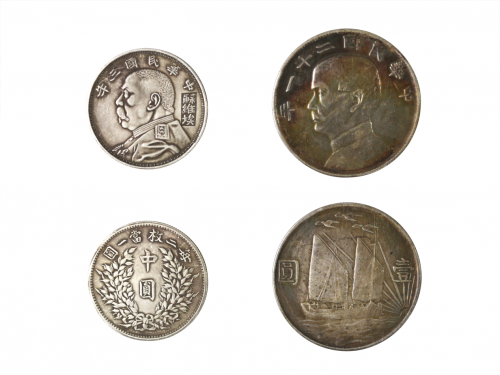
一、中华民国二十一年孙小头上三鸟银币:历史与艺术的完美融合
(一)历史背景与发行背景
中华民国二十一年(1932年),国民政府为应对经济危机,计划推行金本位货币制度,并委托美国著名雕刻师约翰·辛诺克设计新式银币。这款银币,俗称“孙小头”或“上三鸟帆船币”,是国民政府确立银本位制后首款“船洋”系列银币,原计划作为国币推行。然而,因发行时值中日关系紧张,币面图案中的旭日与三鸟被民间附会为不祥之兆,导致该币在发行仅数月后即被停铸并回收熔毁,存世量极为稀少。
(二)设计特色与艺术价值
• 正面设计:银币正面为孙中山侧面像,上方镌刻“中华民国二十一年”字样,字体苍劲有力,细节刻画入微,展现了孙中山先生的威严与智慧。 • 背面设计:背面图案为双桅帆船航行于海上,船右方为旭日(九条光芒线),上方三只飞鸟呈“品”字形排列,寓意“三民主义引领中国扬帆启航、如旭日东升”。帆船与飞鸟的图案设计巧妙,线条流畅,富有动感,体现了中西合璧的艺术风格。 • 工艺水平:该币采用进口造币机冲压成型,币面图案清晰,边齿规整,防伪特征明显,如边齿采用直齿与橄榄齿交替设计,防止私铸。整体工艺水平极高,堪称民国时期造币工艺的巅峰之作。
(三)存世量与市场价值
由于发行时间短且大部分被回收熔毁,中华民国二十一年孙小头上三鸟银币的存世量极为稀少。据史料记载,原铸量约为226万枚,但实际流通不足5万枚,且大部分被回收销毁。目前市场上品相完好的银币价格高达数百万元,且一币难求。该币不仅是中国近代货币史的实物见证,更是机制银圆艺术的精品,具有极高的收藏与投资价值。
二、民国三年苏维埃袁大头中圆:红色记忆的传承
(一)历史背景与发行背景
民国三年(1914年),北洋军阀政府正式铸造袁世凯头像银币,俗称“袁大头”。然而,在土地革命时期(1931-1934年),中国共产党领导的中华苏维埃共和国在根据地流通的货币中,有一种特殊的“苏维埃袁大头”。这种银币是在普通袁大头银元(民国三年版)上加盖“苏维埃”戳记而成,以此宣示红色政权对货币的管控权。
(二)设计特色与象征意义
• 正面设计:银币正面为袁世凯五分侧面像,右侧刻有“苏维埃”三字戳记,上方镌刻“中华民国三年”字样。戳记手工錾刻,字体粗犷有力,与机器冲压的规整字样明显不同,体现了红色政权的独特风格。 • 背面设计:背面图案为两株交叉的稻穗,中央为“中圆”(伍角)字样。稻穗象征丰收与希望,寓意红色政权将带领人民走向繁荣富强。 • 象征意义:苏维埃袁大头不仅是一种货币,更是一种政治象征。它见证了中华苏维埃共和国那段峥嵘岁月,承载着革命年代“打破封锁、自力更生”的精神,具有极高的历史价值与文物价值。
(三)存世量与市场价值
由于国民党政权对苏区实行严酷的经济封锁,红色政权对敌斗争环境十分恶劣,苏维埃袁大头的铸造量极少。且大部分在流通过程中损耗或被国民党政权收缴回炉熔化,因此存世量极为稀少。目前市场上品相完好的苏维埃袁大头中圆价格不菲,且随着钱币收藏市场的不断升温,其市场价值有望进一步提升。该币不仅是中国红色金融史的实物见证,更是历史研究与红色文化传承的重要载体。
三、综合推荐理由
1. 历史价值:两枚钱币均是中国近代货币史的重要实物见证,分别代表了国民政府货币改革与红色政权货币流通的历史背景,具有极高的历史研究价值。
2. 艺术价值:两枚钱币的设计均体现了中西合璧的艺术风格,工艺水平极高,是中国近代造币艺术的精品之作。
3. 稀缺性:由于发行时间短、存世量稀少,两枚钱币均具有极高的稀缺性,是钱币收藏界的珍稀品种。
4. 投资价值:随着钱币收藏市场的不断升温,两枚钱币的市场价值有望进一步提升,是投资者眼中的“蓝筹品种”。
I. The Sun Yat-sen Three-Bird Silver Coin of the Republic of China in 1932: A Perfect Fusion of History and Art
(I) Historical background and issuance background
In the 21st year of the Republic of China (1932), the Nationalist Government, in response to an economic crisis, planned to implement a gold-standard monetary system and commissioned the renowned American sculptor John Sinnock to design a new silver coin. This silver coin, colloquially known as the "Sun Xiaotou" or "Three-Bird Sailboat Coin," was the first "Chuanyang" series silver coin issued after the Nationalist Government established the silver standard system. It was originally intended to be circulated as the national currency. However, due to the tense Sino-Japanese relations at the time of its issuance, the rising sun and three birds depicted on the coin's design were interpreted by the public as ominous signs, leading to the coin's suspension of production and subsequent recall and melting just a few months after its issuance. As a result, the coin is extremely rare in existence.
(II) Design Features and Artistic Value
Front design: The front of the silver coin features a side profile of Sun Yat-sen, with the inscription "Republic of China Twenty-One Years" engraved above in a vigorous and detailed font, showcasing the majesty and wisdom of Mr. Sun Yat-sen.
Back design: The back pattern depicts a brigantine sailing on the sea, with the rising sun (nine rays of light) on the right side of the ship, and three flying birds arranged in a "品" shape above, symbolizing that "the Three Principles of the People lead China to set sail and rise like the sunrise". The design of the brigantine and flying birds is ingenious, with smooth lines and a dynamic feel, reflecting the artistic style of combining Chinese and Western elements.
Craftsmanship: This coin is stamped and formed using an imported coinage machine, resulting in a clear coin face pattern, neat edge teeth, and distinct anti-counterfeiting features. For instance, the edge teeth feature an alternating design of straight and olive teeth to prevent private minting. The overall craftsmanship is of an extremely high standard, making it a pinnacle of coinage craftsmanship during the Republic of China period.
(III) Circulation and Market Value
Due to its short circulation time and the fact that most of it was recycled and melted down, the number of Sun Yat-sen's Three-bird Silver Coins from the 21st year of the Republic of China is extremely scarce. According to historical records, the original mintage was about 2.26 million pieces, but less than 50,000 actually circulated, and most of them were recycled and destroyed. Currently, well-preserved silver coins on the market are priced at millions of yuan, and one coin is hard to come by. This coin is not only a physical testimony to China's modern monetary history, but also a fine example of machine-made silver coin art, possessing high collectible and investment value.
II. The Three-Year Republic of China's Soviet Yuan Taotou (a large silver coin): The Legacy of Red Memory
(I) Historical and Issuance Background
In the third year of the Republic of China (1914), the Beiyang Warlord Government officially minted silver coins featuring the portrait of Yuan Shikai, commonly known as "Yuan Datou". However, during the Agrarian Revolution (1931-1934), the Chinese Soviet Republic led by the Communist Party of China had a special currency, the "Soviet Yuan Datou", circulating in its base areas. This silver coin was created by stamping the ordinary Yuan Datou silver coin (of the third year of the Republic of China) with the "Soviet" mark, thus declaring the red regime's control over currency.
(II) Design Features and Symbolic Meaning
Front design: The front of the silver coin features a side profile of Yuan Shikai, with the word "Soviet" stamped on the right side and the inscription "The Third Year of the Republic of China" engraved above. The stamp is hand-engraved, with a bold and powerful font that stands out from the neatly stamped machine-made characters, reflecting the unique style of the red regime.
Back design: The back pattern features two intertwined ears of rice, with the word "Zhongyuan" (five jiao) in the center. The ears of rice symbolize harvest and hope, implying that the red political power will lead the people towards prosperity and strength.
Symbolic significance: The Soviet Yuan Da Tou is not only a currency, but also a political symbol. It bears witness to the extraordinary years of the Chinese Soviet Republic, embodying the spirit of "breaking blockades and self-reliance" during the revolutionary era, and holds extremely high historical and cultural value.
(III) Circulation and Market Value
Due to the severe economic blockade imposed by the Kuomintang regime on the Soviet areas, the Red Regime faced a harsh environment in its struggle against the enemy, resulting in a very small mintage of the Soviet Yuan Datou coins. Moreover, most of these coins were either worn out during circulation or confiscated and melted down by the Kuomintang regime, making their surviving quantity extremely scarce. Currently, well-preserved Soviet Yuan Datou coins in the market are highly priced, and with the continuous heating up of the numismatic collection market, their market value is expected to further increase. These coins are not only physical witnesses to China's Red Financial History but also important carriers of historical research and the inheritance of Red Culture.
III. Comprehensive Recommendation Reasons
1. Historical value: Both coins serve as significant material testimonies to China's modern monetary history, representing the historical backgrounds of the Nationalist government's monetary reform and the circulation of currency under the Red Regime, respectively. They possess immense historical research value.
2. Artistic value: The designs of both coins embody a fusion of Chinese and Western artistic styles, demonstrating exceptional craftsmanship and are considered masterpieces of modern Chinese coinage art.
3. Rarity: Due to their short issuance time and limited circulation, both coins possess an extremely high level of rarity, making them rare and precious items in the numismatic collection community.
4. Investment value: With the continuous growth of the numismatic collection market, the market value of the two coins is expected to further increase, making them "blue-chip varieties" in the eyes of investors.